Legal service for foreign clients
Social Security and Workmen's Compensation — Recovering Benefits That Were Refused in Thailand
"Not work-related" is the most common reason benefits are refused — and the reason most often overturned.
Quick answer
An employee injured, made ill, disabled, or killed through work is entitled to compensation from the Workmen's Compensation Fund; non-work cases run through social security. Where a claim is refused or underpaid, an appeal to the committee must be filed within the deadline, and if that fails the case goes to the Labour Court. We assemble the medical file and workplace witnesses before anything is filed. From THB 15,000.
From THB 15,000 — From THB 15,000 for the committee appeal; Labour Court work is quoted on the number of hearings. · Appeal 2–5 months; Labour Court 6–14 months
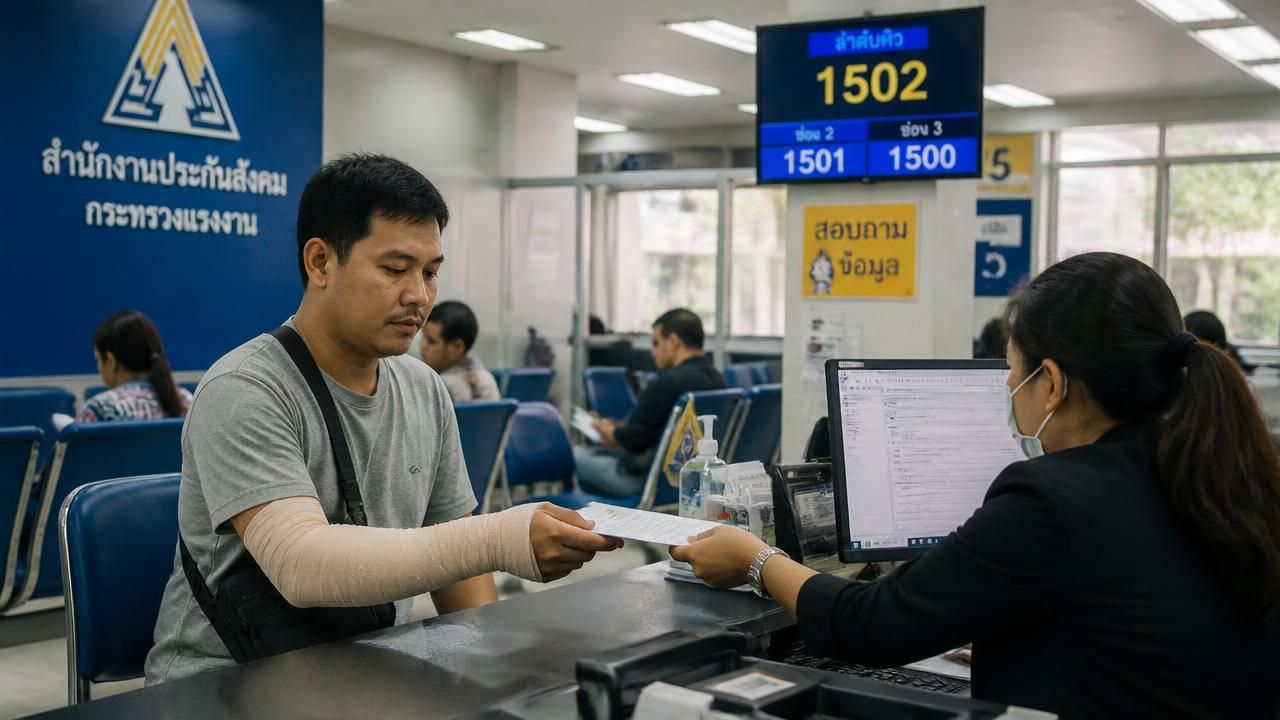
Who this is for
- Employees injured at work or while travelling on duty
- Workers made ill by conditions such as chemicals, dust, or noise
- Dependants of an employee who died through work
- Insured persons refused unemployment, maternity, or invalidity benefit
- Employers assessed for surcharges or disputing registration of staff
What you receive
- A check of entitlements under both funds and the amount that should be paid
- A medical file that ties the condition to the actual job
- A committee appeal filed in time with supporting witnesses
- Proceedings in the Labour Court to set aside the decision
- Advice on claims against the employer over and above fund benefits
Documents to prepare
- Medical certificates, treatment history, and all relevant test results
- The accident notification and whatever the employer filed
- Employment evidence, payslips, and the shift roster
- The decision received, with the envelope or proof of the date received
- Names and statements of colleagues who were present
How it works
5-step process
- 1
Report within the deadline even if symptoms are unclear
Waiting until symptoms worsen invites the suspicion that the injury happened away from work, however untrue.
- 2
Get the job duties written into the medical notes
A medical opinion linking the condition to the postures or substances of the job is what decides the appeal.
- 3
Count the appeal period from actual receipt
The window is short, and missing it is the single most common reason a case ends without the merits being examined.
- 4
Line up workplace witnesses early
Colleagues move on quickly; a statement taken now beats hunting for someone a year later.
- 5
Keep fund benefits separate from a claim against the employer
Fund benefits do not cover every head of loss; the shortfall remains claimable from an employer at fault.
In depth
Social Security and Workmen's Compensation — Recovering Benefits That Were Refused: what foreign clients need to know
Thailand runs two separate funds that working people constantly confuse. The Workmen's Compensation Fund covers injury, illness, disability, or death arising from work and is financed by the employer alone. Social security covers everything not work-related, including maternity, unemployment, old age, and death. The distinction is not technical: it determines how much an injured worker receives and from where. A ruling that an incident was not work-related therefore changes the sum materially — and it is a ruling frequently overturned where the medical evidence ties the condition to the actual job.
Where the work-related line actually falls
The test is whether the incident arose out of the work or from protecting the employer's interests — not whether it happened inside the factory or during rostered hours. A worker hurt while delivering documents on instruction, or during employer-arranged training, falls inside it. The ordinary commute between home and workplace generally falls outside.
The hardest cases are conditions built up over time: musculoskeletal problems from repetitive posture, hearing loss from noise, respiratory disease from dust or chemicals. There is no identifiable incident date, so proof rests on a detailed work history, workplace environmental measurements, and an occupational-medicine opinion rather than a general practitioner's certificate.
Another commonly refused category is psychological harm from working conditions. It is harder to claim than physical injury but not excluded outright; what gives it weight is a continuous treatment record, dated evidence of the workplace events, and statements from colleagues who witnessed them.
What to do in the first week
First, notify the employer in writing even if you already told someone verbally. A short dated message describing what happened, sent through a channel that can be retrieved later, outweighs any later recollection — many disputes begin with an employer denying it was ever told.
Second, have the doctor record the nature of the job in the medical notes. Claims are often refused because the paperwork states only a diagnosis with no mention of cause. Describe the work, the postures, and the substances handled, and ask for it to be written down — that record becomes the central evidence on appeal.
Third, take the names and contact details of colleagues who were present straight away. Turnover in many industries is high and tracing a witness a year later usually fails; a short signed statement taken now beats a faded memory.
Appealing a decision and going to the Labour Court
Where the decision refuses or underpays, the next step is an appeal to the committee within a period counted from the date of receipt, not the date on the document. Keep the envelope or delivery record: when the start date is disputed, that is the only thing that settles it.
An effective appeal is not a long one but one that answers the stated ground of refusal. If the ground was that the matter was not work-related, everything should go to the link with the work, not to financial hardship — which may be real but is not the question before the committee.
If the appeal outcome is still unsatisfactory, the next step is a Labour Court action to set the decision aside. That court is built for accessibility: no court fees, and judges take a more investigative role than in ordinary civil cases. The trap is the filing deadline, which is also short and runs from notification of the appeal result.
Claims against the employer beyond the fund
Fund benefits follow a statutory formula with a ceiling and often fall short of the actual loss, especially where a limb or permanent working capacity is lost. Where employer negligence can be shown — no protective equipment, unrepaired machinery, work beyond a person's capability — the shortfall is separately claimable.
The two routes are compatible, but double recovery on the same head must be avoided; a court will deduct what the fund already paid. What typically remains claimable is loss the fund does not cover by nature, such as pain and suffering and long-term care costs.
For employers the strongest protection is not arguing the claim but the records showing safety training delivered, protective equipment issued, and machinery inspected on schedule. Workplaces that keep those systematically tend to resolve matters in negotiation; those with no records usually end up accepting the worker's account of events.
Cost structure: government fees vs professional fees
| Item | Official fee | Professional fee | Note |
|---|---|---|---|
| Entitlement check and medical file preparation | No fee | THB 15,000–25,000 | Hospital record-copy charges billed at cost |
| Appeal to the committee | No fee | THB 20,000–40,000 | Includes preparing colleague witness statements |
| Labour Court proceedings | Fees exempt | From THB 45,000 | Cases needing expert evidence cost more |
Hearing loss refused at first instance
Situation: A production-line worker was diagnosed with partial hearing loss, but the decision attributed it to ageing.
What we did: Noise measurements from the work area, a twelve-year history in the same post, and an occupational-medicine opinion were filed with the appeal.
Outcome: The committee reversed the earlier decision and confirmed entitlement.
An accident while working off-site
Situation: A technician was hurt travelling to a customer site for a repair; the employer called it a personal trip.
What we did: The work order in the system, the supervisor's instruction message, and the customer's visitor log established the assignment.
Outcome: The incident was accepted as work-related and medical costs were paid in full.
When to act, and when waiting is fine
The incident just happened and nothing has been reported
Report in writing today; do not wait for the treatment outcome
A refusal arrived less than two weeks ago
Start the appeal now; the window is very short
The injury is permanent and fund benefits fall far short
Assess a parallel claim against the employer
You are an employer facing a workplace accident
Gather training and inspection records before making any statement
FAQ
Frequently asked questions
Is an injury on the way from home to work job-related?
The ordinary home-to-work commute is generally outside the scheme, whereas travel on the employer's instructions is inside it.
The employer refuses to report the accident — what then?
The employee may file directly without waiting, and the employer's failure to report is itself an offence.
Having received compensation, can the employer still be sued?
Yes, for losses the fund does not cover — such as non-pecuniary harm or amounts above the fund's ceiling — where employer negligence is proved.
How long does social-security cover last after resigning?
Medical cover continues for a period after employment ends, and anyone wanting unbroken cover can register as a voluntary insured person within the prescribed time.
How is an occupational disease built up over years proved?
Three things together: a job-by-job employment record, plant environmental readings, and a specialist occupational physician's view. One general certificate will not carry it.
The employer never registered me — do I still have rights?
Yes. An employer's failure to register does not remove the worker's rights and is itself an offence; what must be proved is the employment relationship, which pay records, rosters, or colleague statements can establish.
How is the wage-replacement benefit calculated?
As a proportion of monthly wages subject to a statutory ceiling, for the period a doctor certifies as unfit for work; those earning above the ceiling receive less than that proportion of their real income.
Do migrant workers with permits have the same rights?
Yes, where they are employees of an employer within the system. The obstacles are usually documentation and language rather than entitlement, so arrange an interpreter and complete copies from the first filing.
I was dismissed while recovering from a work injury — what can be done?
Compensation rights survive the dismissal, and a dismissal at that point may itself be unfair, giving rise to a separate damages claim in the Labour Court.
Related services
Labor Lawyer — Termination, Severance, Labor Court
Both employer- and employee-side, at all Labor Courts nationwide.
Personal Injury, Consumer, Insurance & Administrative Cases
Damages claims, insurance disputes, consumer protection, and admin actions.
Medical Malpractice — Claims Against Doctors & Hospitals
Medical cases are not won on the feeling that treatment went badly. They are won on records and expert opinion.
Written by: Thai Law & Accounting Services — attorneys and licensed accountants
Reviewed by: Reviewed by a Notarial Services Attorney registered with the Lawyers Council of Thailand.
Last updated: 2026-08
Information as of August 2026. Government fees and processing times change — verify with the relevant agency before acting, or let our team verify for you.