Legal service for foreign clients
Land Title & Asset Ownership Verification in Thailand
Know before the deposit: who owns it, what binds it, and what may be built.
Quick answer
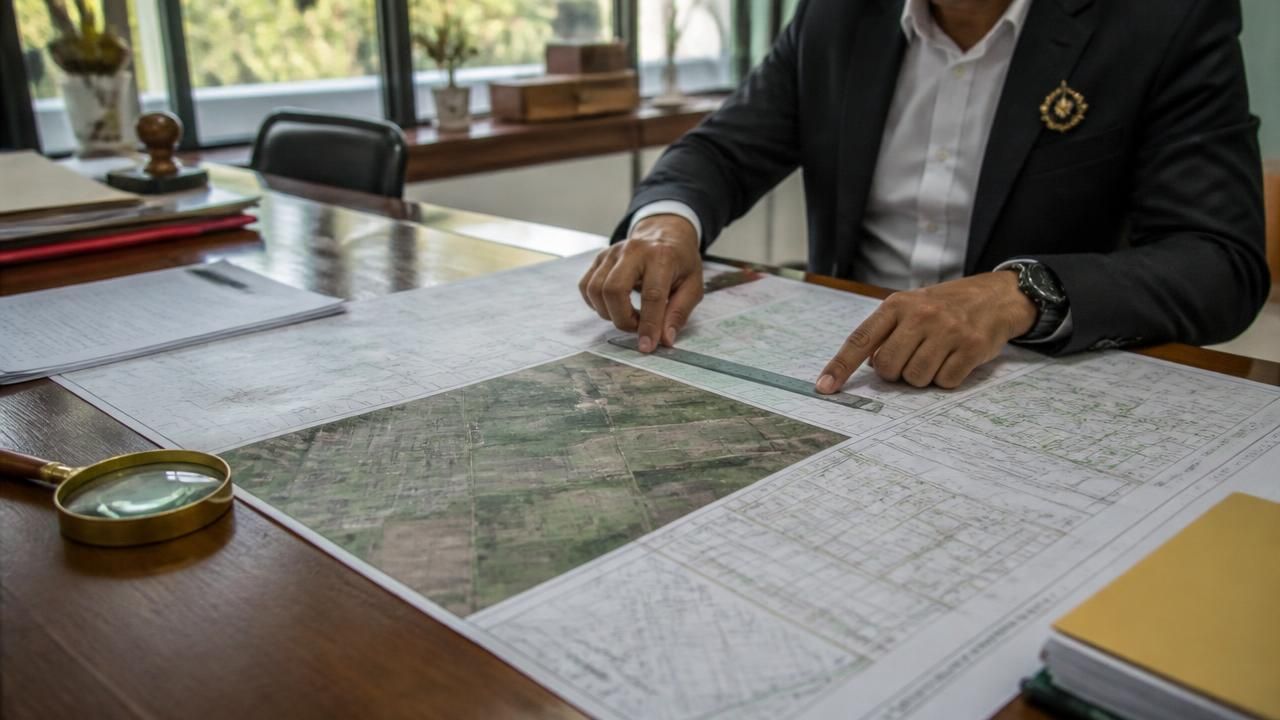
Title verification means opening the land file at the Land Office to read the plot's history from issuance onward: current holder, mortgages, sale-with-right-of-redemption, servitudes, usufructs, injunctions, and related litigation — plus the zoning that limits what you may build. You receive one report you can decide on. From THB 12,000 per plot, results in 3–7 working days.
From THB 12,000 — From 12k per plot · bundled pricing for multiple plots or provinces · 3–7 working days, depending on the Land Office involved
Who this is for
- Buyers of a house, land, or condo before the deposit
- Investors taking land as security or into a joint venture
- Bidders at judicial auctions or on bank NPA stock
- Heirs checking what encumbers estate land
- Owners suspecting encroachment or an encumbrance registered without their knowledge
What you receive
- Ownership report naming the holder, the deed class, and the registered area
- Every encumbrance shown in the land file with its registration date
- Zoning result and the construction limits applying to that location
- Access check: public road versus a servitude that must be granted
- A legal opinion: proceed, renegotiate the price, or walk away
- Draft protective contract clauses for the risks found
Documents to prepare
- Copy of the deed or right document from the seller, both sides
- Power of attorney to inspect the file when acting for the owner
- Seller's name and ID number to confirm authority to dispose
- A map or coordinates if available, to confirm the real location
How it works
5-step process
- 1
Read the right document first
Distinguish a chanote from Nor Sor 3 Kor, Sor Kor 1, or a non-transferable class — the rights differ sharply.
- 2
Open the file at the Land Office
Trace the chain of transfers, mortgages, injunctions, and recorded court orders.
- 3
Check zoning and area limits
Zone colour, setbacks, height limits, and special control areas.
- 4
Compare the ground with the paper
Look at actual occupation, tenants, structures, and signs of boundary encroachment.
- 5
Summarise risks and options
Rank risks in three tiers and propose how to close each one.
In depth
Land Title & Asset Ownership Verification: what foreign clients need to know
Checking title is not reading the name on the front of a deed. It is reading the whole life of that plot: past mortgages, injunctions, rights of way carved out for the neighbour, and zoning rules that may forbid the very use the buyer has planned. The damage from skipping this step rarely shows on transfer day; it shows when a building permit is refused, when a resale stalls, or when a neighbour says your fence sits on his land.
The class of title document that changes the whole risk picture
A full chanote gives the strongest position because it is surveyed and issued by the Land Department. Utilisation certificates in the Nor Sor 3 family, or documents never properly surveyed, confer possession only and carry a materially higher risk of overlapping boundaries.
Land inside agrarian reform areas, or bound by a statutory transfer ban, cannot be traded normally no matter what the seller says worked for someone else. We test this layer first, because where a ban applies no amount of good drafting perfects the transfer.
The encumbrances a deed's front page never shows
The registration history on the reverse is the real source: mortgages, servitudes, usufructs, habitation rights, and injunctions lodged by judgment creditors. Some entries are so old the seller has forgotten them, and buyers regularly discover that the rear plot's access road runs straight across the land they are about to buy.
Beyond the register we inspect the ground: measure boundaries against the plan, look for structures belonging to others, and ask how access is actually used, because long-standing unregistered use also breeds disputes.
Zoning and use restrictions
The same plot may take a house but not a factory, or take a building whose height is capped because it sits near an airport or a heritage line. We check the comprehensive plan colour, setback rules, and the public-road frontage needed for a permit.
Foreign buyers add a further layer, since a foreign individual cannot in principle hold land. The holding structure must be genuinely lawful — a registered long lease, a usufruct, or a condominium unit within the permitted quota — never Thai nominee shareholders, which we do not recommend.
Cost structure: government fees vs professional fees
| Item | Official fee | Professional fee | Note |
|---|---|---|---|
| Pulling the registration history and verifying the title | Copy and certification charges at the land office — a few hundred baht per plot | THB 6,000–12,000 per plot | Includes a bilingual risk summary the buyer can decide on |
| On-site boundary inspection with photographic record | No government fee unless a formal re-survey is requested, then at Land Department rates | THB 8,000–20,000 by distance and plot size | Where encroachment is suspected, re-survey before any deposit changes hands |
| Zoning and permit-feasibility check | Local authority information fees | THB 7,000–15,000 per project | Essential when buying to build a factory, warehouse, or rental accommodation |
| Drafting or reviewing the sale agreement before the deposit | None; transfer duties arise on registration day at the land office | THB 10,000–25,000 | We write a clear deposit-refund condition if encumbrances surface |
A house whose only access road sat on someone else's land
Situation: The buyer had already paid a deposit, trusting a verbal claim that the road was public.
What we did: We pulled the register and walked the route: private land with no servitude ever registered.
Outcome: The road owner registered a servitude before transfer, giving the buyer access legally tied to the land.
Factory land where zoning barred the planned operation
Situation: A foreign investor was set to buy a large plot for a processing plant.
What we did: Our zoning check showed that use class was permitted only in specific sub-areas.
Outcome: The deal was dropped before major money moved, and a compliant plot was found within two months.
When to act, and when waiting is fine
Always check before the deposit
A deposit already paid is hard to claw back unless the contract wrote the refund condition in advance.
Order a re-survey when the fence does not match the plan
A survey costs a fraction of an encroachment lawsuit and settles neighbour disputes at the outset.
Foreign buyers should settle the holding structure before negotiating price
A lawful structure can change the cost and terms of the whole deal, so it comes first, not last.
No need for a full repeat check when buying the adjacent plot from the same seller
We reuse the earlier findings and check only the delta, which reduces the fee.
FAQ
Frequently asked questions
Can I check a deed online myself?
Some basics are visible online, but encumbrances and the transfer chain only appear when the land file is opened at the office.
Can I buy land under sale-with-redemption?
Only after redemption, or with the buyer-in-trust joining the transfer — otherwise redemption can later unwind it.
No access to a public road — fixable?
Negotiate a registered servitude, or sue for a necessary way when the plot is fully enclosed.
Is a condo check different?
Yes — it adds the unit title, common-ownership ratio, unpaid common fees, and the 49% foreign quota.
Can a foreigner buy land via a company?
Only with a genuine, correctly structured company — Thai nominee holdings risk revocation.
Can the report really support a price cut?
Yes — we separate fixable from unfixable risks so you can negotiate against the outstanding burdens.
How many days does a title check take?
Typically 3–7 working days per plot; upcountry travel or a re-survey extends it.
The seller says there are no encumbrances — is that enough?
Only the land office register answers that; a verbal assurance binds nobody.
Can a foreigner buy land in Thailand?
In principle no, but a condominium unit within the legal quota or a registered long lease is available.
Related services
Land & Real-Estate Lawyer — Title, Lease, Usufruct
Title due diligence, sale, lease, usufruct, superficies — and closing at Land Office.
Asset Tracing & Judgment Enforcement
Turning a judgment into recovered money, not a piece of paper.
Draft & Review Business Contracts — NDA, JV, Shareholder
Enforceable contracts — bilingual, with dispute-resolution and arbitration clauses.
Inheritance, Wills & Probate Lawyer
Petition administrator, draft wills, litigate inheritance shares.
Written by: Thai Law & Accounting Services — attorneys and licensed accountants
Reviewed by: Reviewed by a Notarial Services Attorney registered with the Lawyers Council of Thailand.
Last updated: 2026-08
Information as of August 2026. Government fees and processing times change — verify with the relevant agency before acting, or let our team verify for you.